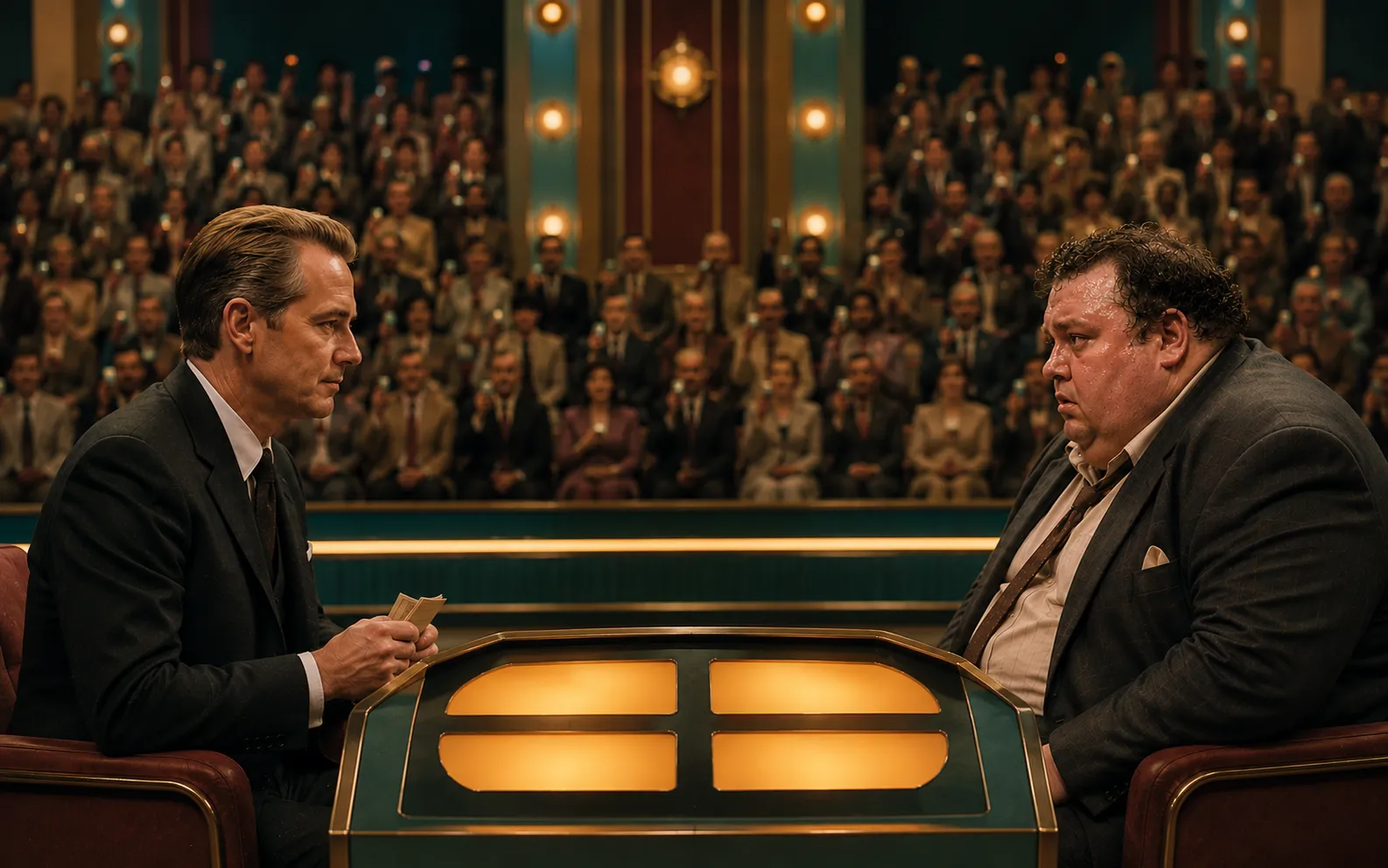
There is a famous moment in Who Wants to Be a Millionaire? when the contestant, having exhausted personal confidence and perhaps also geography, turns to the audience.
The audience votes. Four bars appear. A room full of strangers becomes, briefly, an epistemic machine.
This is the audience lifeline: a small ritual of democratic knowledge. Sometimes it works beautifully. A thousand partial memories, school lessons, private obsessions, hunches, prejudices, and pub-quiz residues converge on the correct answer. The contestant nods. The host raises an eyebrow. Collective intelligence looks, for a moment, like a respectable civilizational technology.
But the audience lifeline works because the audience is made of different people.
That detail matters.
They have different memories, different blind spots, different teachers, different hobbies, different degrees of confidence. One person knows Greek mythology. Another has watched too many wildlife documentaries. Someone in row six once dated a chemist. Someone near the back is wrong with magnificent conviction, but not in sufficient numbers to matter.
The crowd is useful because it is not one mind.
Now compare this with our modern habit of asking several large language models the same question. ChatGPT, Claude, Gemini, Grok, perhaps a specialist model, perhaps something local if one feels ideologically committed to suffering.
We then compare the answers.
If they agree, we feel reassured.
This looks like the audience lifeline.
It is not.
Very often, what we are consulting is not a crowd but an artificial hivemind: different interfaces, different corporate voices, different safety temperaments, but broadly similar statistical gravitational fields. These systems have absorbed overlapping public text, been tuned toward similar notions of helpfulness, and learned the same polite choreography of plausible explanation.
They do not independently remember. They do not bring different childhoods. They do not have private obsessions with obscure train stations, bad 1970s science fiction, Roman plumbing, or the emotional life of office furniture, unless the training distribution made such obsessions statistically useful.
Ask them a factual question and agreement may be meaningful, though still not sufficient. Ask them an open creative question and something stranger happens: they tend to gather around the same familiar attractors.
A metaphor for time?
A river. A tapestry. A journey. An hourglass.
A random number between one and ten?
Seven, naturally. The golden retriever of numbers.
A European city to visit?
Paris, Rome, Barcelona. Perhaps Prague, if the model is feeling bohemian.
This is not stupidity. It is competence of a particular kind. Large language models are extremely good at finding the most likely continuation of a context. They are trained to be coherent, helpful, acceptable, and not unnecessarily strange. In many domains, that is exactly what we want. Nobody wants a tax explanation that has decided, for reasons of creative entropy, to become a small opera about depreciation.
But in creative work, the center of the distribution is often the problem.
The first idea is usually not the best idea. It is merely the most available idea. The second and third are often only the first idea wearing a different hat. By the time one reaches the tenth idea, there may be oxygen in the room again.
This is why human creative processes involve prompts, constraints, reversals, bad drafts, arguments, long walks, and occasionally the kind of coffee that makes one question the structural integrity of reality.
The Australian startup Springboards has been looking directly at this problem. Their model Flint is described not as a better general-purpose oracle, but as a divergence model: a system trained to produce higher-entropy outputs where entropy is actually useful.
That distinction matters.
“More random” is not the same as “more creative.” Turning up the temperature on a language model can produce variety, but it can also produce nonsense, tonal wobble, and the unmistakable smell of a machine losing its trousers in public.
The clever idea is to increase variation at meaningful branching points, not everywhere.
Consider the sentence: “A surprising European city for a long weekend is…”
The critical token is not the grammar. It is the city. We do not need the model to become adventurous with articles, punctuation, or basic syntax. We need it to escape the Paris-Rome-Barcelona triangle without falling into “the abandoned moon colony of Bratislava.”
A good divergence model should remain coherent while widening the field of possible answers.
That is a much more interesting goal than simply making the model louder.
The deeper issue is that we have confused consensus with confidence. When four models give similar answers, we often interpret that as corroboration. But similarity between models is not the same as independence between witnesses. If four parrots were trained on the same encyclopedia and rewarded for sounding agreeable, we would not put them in separate rooms and call the result peer review.
The illusion is especially dangerous because the outputs are so polished.
LLMs do not merely converge; they converge fluently. They deliver the middle of the distribution in a tone of calm authority. This makes groupthink feel like wisdom. It is not shouting. It is not fanatical. It arrives formatted, balanced, and grammatically house-trained.
That may be the most dangerous kind.
There is, however, a useful separation to make. For truth-seeking tasks, we should not respond to model convergence by demanding more entropy. If the question is legal, medical, mathematical, financial, or security-relevant, the antidote to synthetic consensus is not imaginative variation. It is verification. Sources. Tests. Counterexamples. Formal checks. Reproducible procedures. Adversarial review.
A model that invents five unusual diagnoses is not a creative breakthrough. It is a liability with a bedside manner.
But for creative and strategic work, the opposite applies. There, sameness is a cost. If every model proposes the same campaign angle, the same metaphor, the same article structure, the same product name, the same “bold yet approachable” brand voice, then AI has not amplified imagination. It has industrialized the first draft.
This is where a model like Flint becomes interesting. Not because it replaces judgment, but because it may restore one missing ingredient: useful difference.
It can function less like an oracle and more like a strange colleague who has not read the same memo as everyone else.
That is valuable.
Creative work does not need machines to decide. It needs machines to help disturb the obvious.
The human role then becomes more important, not less. Higher-entropy generation creates a larger field of candidates. Someone still has to choose. Someone still has to know which odd idea is alive and which one is merely wearing novelty as a fake moustache.
Taste does not disappear.
Editorial judgment does not disappear.
If anything, they become the scarce resource.
The future of good AI use may therefore be less about asking one model for the answer and more about assembling different cognitive instruments. One model for reliable compression. One for verification. One for adversarial critique. One for divergent ideation. One local model that refuses to behave but occasionally says something useful by accident.
The audience lifeline worked because the audience was genuinely plural. Current LLM ecosystems often simulate plurality while quietly converging on the same polite middle.
Springboards’ Flint is interesting because it recognizes that the problem is not merely that models can be wrong. It is that they can be similarly right, similarly dull, and similarly trapped in the obvious.
Sometimes the danger is not hallucination.
Sometimes the danger is everyone saying “river” when time could have been a taxidermied octopus, a collapsing staircase, a badly managed railway timetable, or a dog that has learned to open doors but not to close them.
The crowd is wise only when it is actually a crowd.
No comments yet