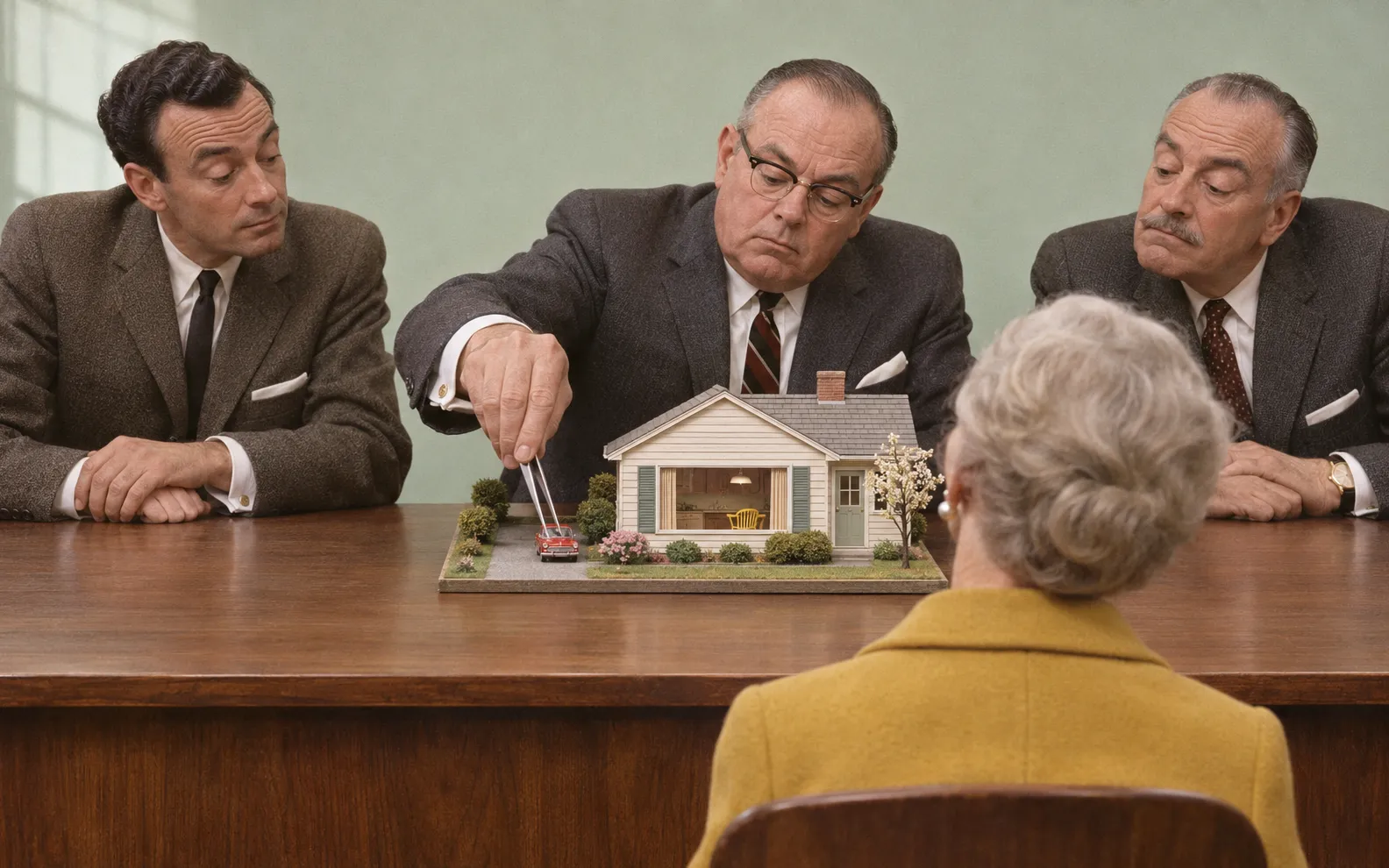
Suppose you would like your mother to come and live with you. She would like this too, provided she has her own front door and you understand that six o’clock is a perfectly reasonable time to eat dinner. There is room in the garden for a small cottage. On Saturday morning you ask an AI to draw one. By lunch it has produced sixteen kitchens, calculated the turning radius of her wheelchair and put a window exactly where she can watch the birds. Your mother chooses the third kitchen. The planning board meets in February.
Somewhere between lunch and February lies a theory of the American economy.
Nvidia’s Jensen Huang has warned that the person who takes your job may be the colleague who learns to use AI. It is good career advice, particularly from a man who sells the equipment both of you will need. But consider the planner who processes your application. She has learned to use AI. By Monday morning she has checked every measurement and found an error in the drainage plan that everyone else missed. She would love to give you an answer. The board still meets in February. Huang’s ambitious colleague has just discovered the limits of individual enterprise. Huang made his point at the Milken Institute.
Venture capitalist Marc Andreessen offered a version of this argument at the Federal Reserve’s November 16 conference on productivity and jobs. He sees an economy moving at two speeds. In electronics, media and swathes of the consumer market, a producer who finds a cheaper way to make something can put it on sale and spoil a competitor’s afternoon. In housing, education and health care, the distance between an invention and a paying customer can include a licensing board, an accrediting body, an insurer and a gentleman named Ron who has concerns about parking.
The distinction runs straight through your mother’s cottage. The pictures are practically free. You could commission a seventeenth kitchen in pale green just to annoy your sister. The timber still has to grow somewhere. A plumber must get under the sink. And if the town permits one dwelling per lot, the price of architectural imagination can fall all the way to zero while the number of grandmothers living in the garden holds steady.
Medicine offers a more uncomfortable test. Imagine an AI that can pass every medical examination and, more impressively, persuade your mother to describe what actually hurts. Would you let it practice? At two in the morning, with the nearest doctor three hours away, you might say yes. At nine the next day, when a software company asks you to sign away your right to sue, you might recover a deep affection for the licensing board. Public opinion can move quite briskly between those two positions, sometimes in the same dressing gown.
Education has its own version. A tireless tutor who can explain fractions eleven ways would have been welcome in our house. My father had two ways, the second considerably louder. Yet a family buying a college education is also buying access to jobs for which a degree is the price of admission. The tutor can teach you the mathematics by Thursday. On Friday the employer’s application form will still want the name of your university. There is no box for “Ask me a difficult question.”
What happens when the essentials keep getting dearer? Voters quite reasonably ask for help. Suppose a town has ten apartments available and twenty families looking. A rent allowance may keep one of those families near a school, a job or a grandmother. That matters. But if the town gives all twenty families more bidding power while forbidding an eleventh apartment, landlords have an excellent chance of enjoying some of the allowance themselves. Government can build housing, finance a hospital wing or change what is legal on your patch of grass. Sending a cheque is easier. Nobody comes to a public hearing to complain that a cheque will cast a shadow over their tomatoes.
Andreessen wondered aloud whether American health care might eventually absorb 80 percent of GDP. That is a thought experiment with a flair for publicity. The official figures are dramatic enough. The United States spent 18 percent of GDP on health care in 2024, and federal actuaries project 20.6 percent by 2034. A sector can claim a growing share of our spending even as life improves. Given cheap entertainment and a treatment that buys her another healthy year, your mother might cheerfully spend the savings on the year. She might feel differently about spending them on three people employed to establish which insurer owes a fourth person money.
February arrives. Your mother goes to the hearing. Ron asks about parking. She explains that she gave up driving in 2019 and asks whether he objects to the birds. After some discussion the board approves the cottage. The plumber can start in June.
On the walk home she admits that the AI impressed her. The low cupboards were thoughtful. So was the little bench by the door, where she could sit to take off her shoes. What puzzles her is how a country clever enough to design the whole house before lunch took four months to hear from Ron.
Back at the house, the AI offers to show her the kitchen in walnut.
“I’ve picked a kitchen,” she says. “See what you can do about the plumber.”

No comments yet