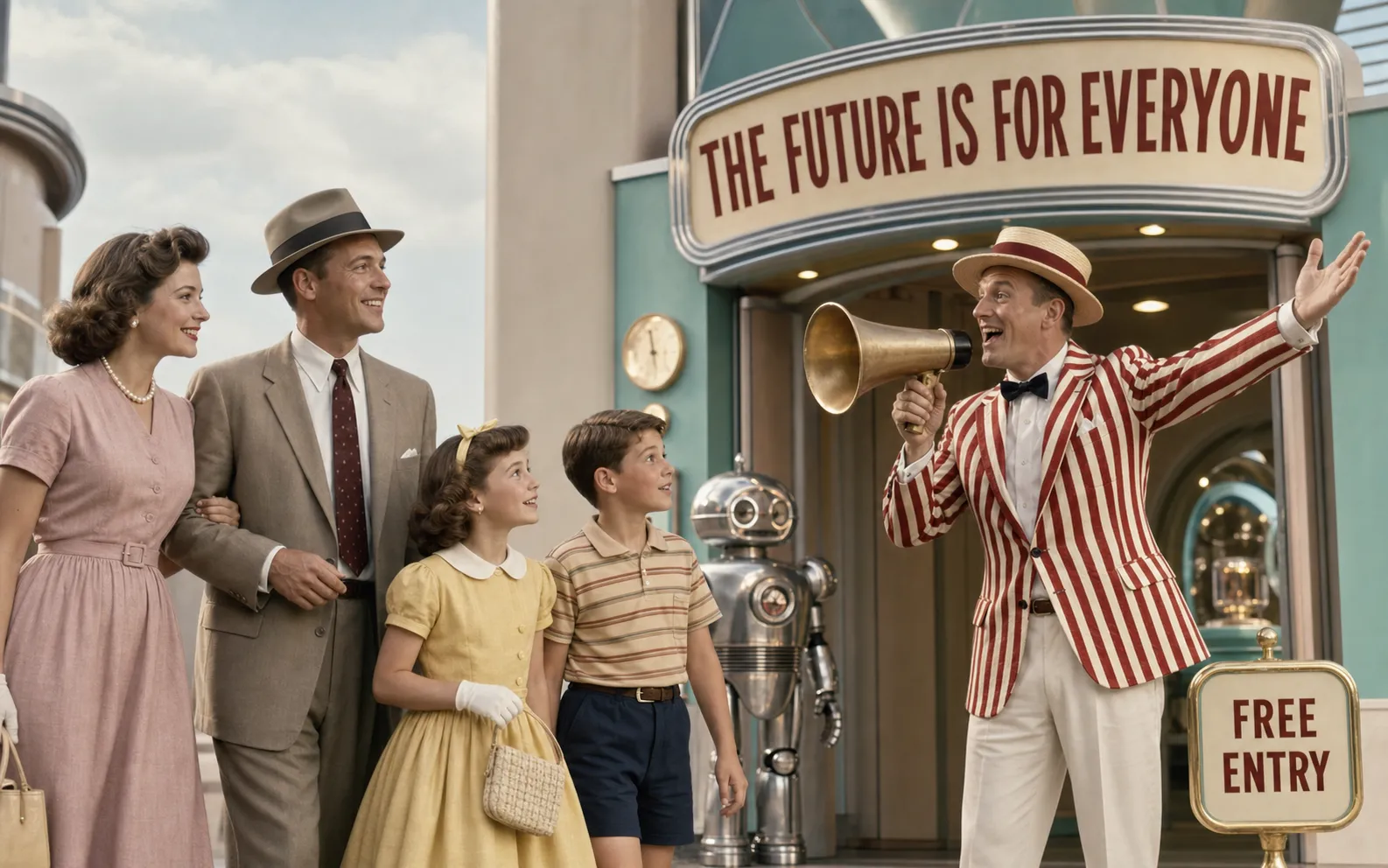
On August 10, Mark Zuckerberg published a manifesto called “The Future Is for Everyone”. It is roughly 6,500 words long, which is itself encouraging: one of the men who helped compress human communication into likes, emojis, and a thumb pointing upward has rediscovered the paragraph.
His central argument is simple. Superintelligence should not be locked inside a few governments, corporations, or laboratories. It should be widely available, personally useful, and directed toward invention rather than merely automation. Everyone should have an indefatigable tutor, research assistant, health coach, creative partner, and business adviser. In Zuckerberg’s version of tomorrow, your AI will improve your sleep, help your children bake, invent medicines, teach you Mandarin, and possibly remember where you put the tiny screwdriver required to open the battery compartment of a toy.
Broadly speaking, I agree.
This may sound suspicious. Agreeing with a billionaire’s manifesto is usually the intellectual equivalent of accepting a free holiday from a timeshare salesman: pleasant at first, followed by an alarming amount of paperwork. But Zuckerberg identifies the right political question. The issue is not simply how intelligent AI becomes. It is who gets to use that intelligence, for whose purposes, and on what terms.
If powerful AI is reserved for the state, five corporations, and whichever consulting firm has the most rectangles in its PowerPoint deck, then the rest of us will not be “empowered.” We will be efficiently managed. A technology capable of multiplying human ability must not become a private forklift used to rearrange society while everyone else stands inside a box marked HUMAN RESOURCES.
Zuckerberg is also right to emphasize invention. Much public discussion treats AI as a gigantic replacement machine: first it takes the repetitive tasks, then the interesting tasks, and eventually it sends us a calendar invitation titled “Your Continuing Relevance.” But tools do not only perform old work more cheaply. They make previously impossible work possible. A small business can test ideas without a large staff. A student can receive patient, individualized instruction. A scientist can explore more hypotheses. A person with expertise but no capital can build something that once required an office, a fund-raising round, and a kitchen containing twelve varieties of corporate oat milk.
The promise matters most when access is broad. A private tutor for every child could narrow opportunity gaps; a private tutor for every child whose parents can afford the premium plan could widen them with spectacular efficiency. The same is true in medicine, law, entrepreneurship, and science. Intelligence distributed unequally does not merely reflect inequality. It compounds it.
Another strong idea in Zuckerberg’s essay is that safety may come from a balance of power rather than from one supposedly benevolent superintelligence. Humanity, he notes, does not share one set of values. This is true. We cannot agree on taxation, school uniforms, pizza toppings, or whether voice notes longer than three minutes constitute a war crime. The notion that a committee will write “human values” into a single machine and receive universal applause is optimistic even by Silicon Valley standards.
Multiple systems, institutions, and individuals checking one another may indeed be safer than one digital philosopher-king. Zuckerberg imagines everyone having a superintelligent lawyer. This could produce fairer justice, although it could also mean that cancelling a gym membership requires oral arguments before nine synthetic judges. Still, the principle is sound: concentrated intelligence creates concentrated power.
And here the essay becomes both convincing and unintentionally funny, because its author is the founder and controlling shareholder of Meta. A company that has spent two decades centralizing attention now arrives to warn us about centralization. It is rather like a casino announcing a national campaign for mindfulness. The campaign may be sincere. The meditation cushions may be excellent. One is still entitled to ask where the roulette tables went.
“Free or affordable access” is therefore not enough. If everyone can use the fountain but one company owns the reservoir, sets the pressure, reads the meter, and may redesign water next Tuesday, power is not truly distributed. A future for everyone requires competition, open standards, meaningful privacy, independent oversight, portable data, transparent rules, and the practical ability to leave one provider for another without abandoning one’s memories, contacts, business, and digitally reconstructed personality.
It also requires honesty about transition. Technological progress has often created more prosperity and better work, but the word “eventually” has done heroic labor in that sentence. Displaced workers live in the interval between disruption and prosperity. Communities host the data centers. Families pay electricity bills. Citizens absorb mistakes that product teams later describe as “learnings.” Training, local investment, environmental limits, worker bargaining power, and public accountability are not gloomy obstacles to innovation. They are how “everyone” gets admitted through the front door rather than thanked from the stage.
Yet pessimism alone is no program. We should resist the fashionable pleasure of predicting catastrophe with such sophistication that building a better future seems embarrassingly naïve. AI can enlarge human agency. It can democratize expertise, accelerate discovery, and let more people turn imagination into action. Those are not marketing fantasies; they are possibilities worth fighting over.
So yes, the future should be for everyone. Not because Meta promises it, and not because history automatically delivers happy endings, but because the alternative—a small group owning the most powerful intellectual tools ever created—is plainly worse. Zuckerberg’s manifesto offers a useful destination. The rest of us should help write the route, inspect the vehicle, and retain the right to change drivers.
Preferably before our personal superintelligence clicks “I agree” on our behalf.



No comments yet