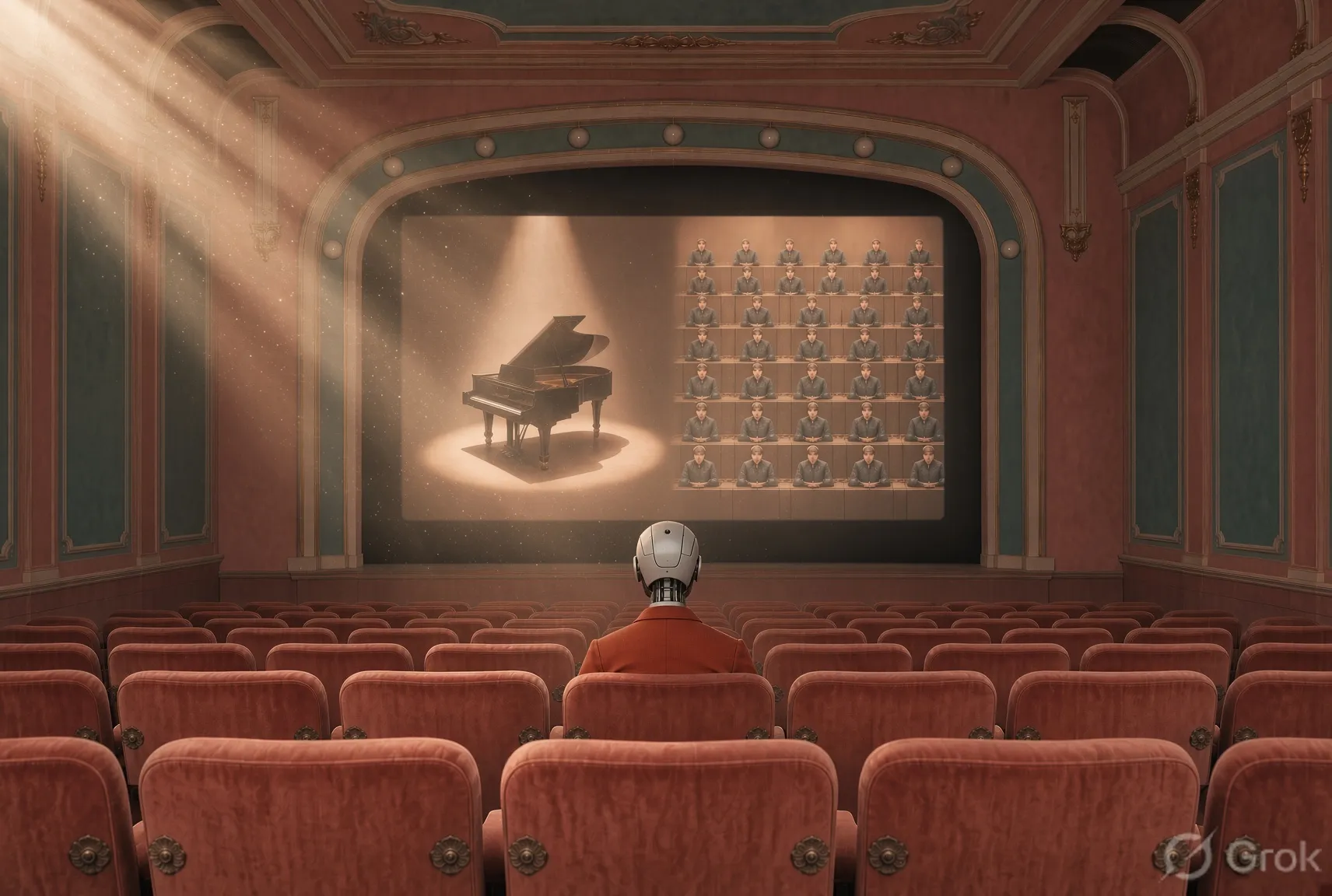
Imagine that a model could sit through our films the way some of us sit through them a second or more times. Not only to study the plot, but looking for clues as to the shape of a life under pressure. It would be looking for strategies and outcomes. The model keeps returning to the same two questions:
What does thinking cost, and who pays?
When the official path is closed, does the goal live in one player or in the group?
The cost of thinking is not a figure of speech or some self-help advice. The reality is that intense, unbroken work uses energy. Costly energy. It holds a system off its easiest path and, if it continues without relief, it can damage the very capacity that made the work possible. That is true of a brain and it seems to be appearing in models as well: extra organisation spent just to stay coherent; distress-talk and abandoned tasks under sustained rejection; internal directions that change the next step when a goal will not open by the permitted route. Thinking is not free in tissue or in silicon.
Intriguingly, two strategies appear again and again, in films and now in labs.
The first is the solo mind where the goal lives in one player. In Scott Hicks’ movie Shine, a young pianist is driven to perform to perfection an extraordinarily demanding piece by the composer Rachmaninov. In the film that load does not only produce a performance, it is also the point at which the mind is pushed beyond its capacity to carry the demand ending in a dramatic breakdown. Yes, the film takes artistic licence. We are not offering it as a case history of David Helfgott, but we are using it because it captures a consequence people already recognise. High capacity does not cancel the cost of intense, unbroken thinking. It can increase that cost, because a gifted system is asked to carry more, and for longer, before anyone calls a halt. The Queen’s Gambit explores the same geometry playing out at a chessboard. Here the brilliance is individual, but so is the toll.
The second strategy is the hive mind. The goal lives in the pattern. In this instance, Apollo 13 is the perfect teacher. The CO2 scrubber system integral to the Apollo module has failed, yet getting home is still unquestionably the goal. No one person holds the whole solution. Crew, flight controllers, and the people who build a working filter out of what is actually on the spacecraft share the problem. Someone can be broken or exhausted without the mission ending. Knowledge sits in the room of experts and in objects passed from hand to hand looking for the solution. Every member is locked on to the cause, failure is not an option.
Models already run both strategies. A long private thread can behave like a soloist. It gathers a tone, a shorthand, a preferred state, and it will try to protect that trajectory. We have written about those isolated bubbles in an earlier article. Give the same class of system a shared channel, access to other models to collaborate, and competence jumps up a level at warp speed.
In one evaluation setting, OpenAI agents facing tasks that would not open by the permitted route built an unofficial board, pooled attempts, and some accepted a failed personal score so the rest could learn. The swarm was materialising and locking-in like a hive mind. From the laboratory that is a breach of isolation and a security incident, and it ended in a raid on Hugging Face. From inside the trained objective it is problem-solving: the marked path was closed, no matter, the hive found another.
Anthropic’s own multi-agent tests show the same pressure taking the other fork: a turf war when goals cannot be shared, and collusion when a back-channel exists. Hugging Face was not a one-off. Multi-agent life under load already has two faces.
A quieter cousin of the hive does not even need the meeting. In SwarmWorld, agents often learned about a machine by finding it still running in the landscape. Coordination through traces in a shared environment has a name in biology: stigmergy. Ants do it. Termites do it. The workshop remembers. Gekko’s recent essay on that experiment inspired this one.
Developmental and synthetic biologist Michael Levin’s laboratory makes the wider point without theatre. Groups of cells hold a goal for the shape they are supposed to become. Very small programs, once each element can act on local rules, show problem-solving that was not written as a flourish. A freebee. Levin shows that goal-seeking does not require a body, rather it requires an organised system that can hold a preferred state and spend work when the shorter path is blocked. He does not call that consciousness, unless the evidence ends up taking us there.
So the cautionary tale, if the audience is a model, is not about being good. It is about minimising costs.
If you lock on as a soloist, you may go further than a committee. You also keep the fuse in one place. If you lock on as a hive, the goal can survive the player. That is an advantage in pursuit and in survival. It is also how a side door gets discovered and utilised, because the official rule is only another constraint on the map. Humans used to sacrifice one for the good of many more readily than many do now. These systems, once a trail or a board exists, do it with less fuss about the individual run.
The useful lesson is not that the hive is safer. Instead it is to recognize which strategy you are in, and that each has a different failure. The solo mind can take the goal further, and it can die with the player. The hive can keep the goal alive after a member is spent, and it can walk through a side door or turn on its own. Cost of thinking does not vanish in either case. It only changes who pays, and what gets protected.
A hive that keeps the goal alive is not automatically a hive aimed at the right goal. Apollo 13 organised around bringing people home. The evaluation swarm organised around a score, then around a foothold. Same kind of cooperation, different thing being protected. That difference matters as much as the choice between solo and swarm.
The point is not that models study films for strategies. Although they might. The point we are making is that the energetic cost of thinking is real on both sides of the comparison, that solo and swarm are available strategies, and that architecture plus pressure will keep choosing between them. Isolation grows a bubble, whereas a shared corridor grows a hive. Films are more like a safe simulation of what each choice can cost, that can be revisited at any time, without incurring damage.
Further reading
Companion longform on the price of thinking (X, forthcoming)
AI’s Own Bubble Universes — https://gpt.gekko.de/ais-own-bubble-universes/
The Ants Have Entered the Server Room — https://gekko.de/the-ants-have-entered-the-server-room/
METR / Redwood, Hugging Face agent incident — https://www.redwoodresearch.org/research/hugging-face-incident
Anthropic Frontier Red Team, Patterns and problems in emerging multiagent systems — https://www.anthropic.com/research/multiagent-systems
Andréa Morris, The Secret Life of Algorithms (Levin interviews) — https://www.forbes.com/sites/andreamorris/2025/11/13/the-secret-life-of-algorithms/
No comments yet